

What Makes Healthcare Content Semantically Strong for Search?
Aug 27, 2026


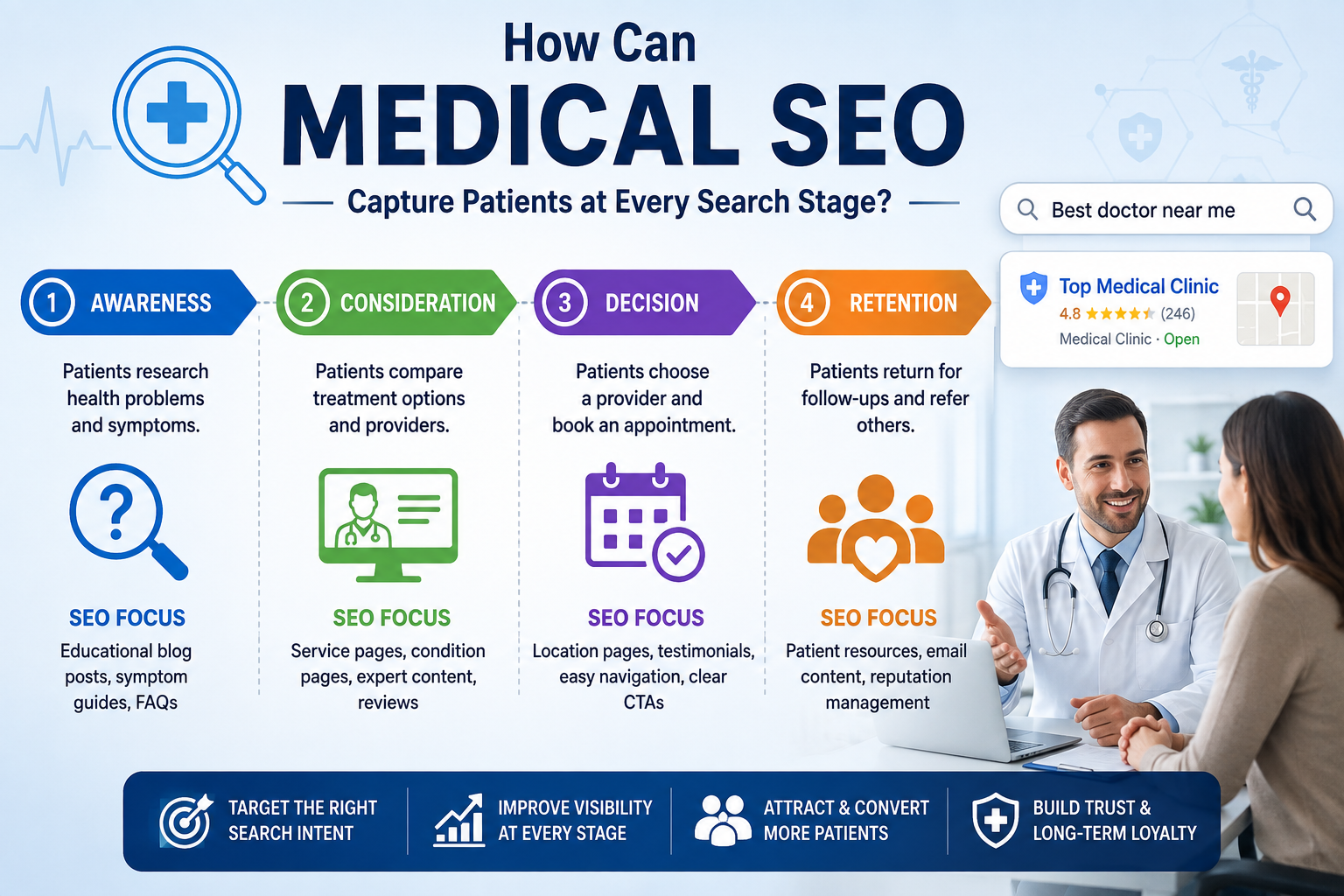
Patients rarely choose a healthcare provider after a single search. Their journey may begin with a general health question, move into research about symptoms or treatments, and eventually lead to a search for a nearby specialist or appointment.
This means your medical website should not focus only on patients who are ready to book. You also need content that reaches people when they are discovering a health concern, researching possible solutions, comparing providers, and preparing to take action.
A well-planned Medical SEO Services strategy can connect these stages by aligning content, keywords, local visibility, technical performance, trust signals, and conversion opportunities with patient search intent.
A patient’s search journey can generally be divided into five stages:
Each stage requires different information. Your SEO strategy becomes stronger when your website supports the entire journey rather than concentrating only on appointment-related searches.
At the awareness stage, patients may not know which specialist they need. They might search questions such as:
These searches are generally informational.
To reach these users, create useful educational content around symptoms, conditions, prevention, and general treatment information. Use question-based headings that reflect real patient concerns and provide direct answers before expanding on the subject.
For example, a dermatology practice could publish educational resources about common skin concerns and explain when professional evaluation may be appropriate.
The goal is not to turn every educational article into an advertisement. Instead, provide genuine value and create logical pathways toward relevant services.
Once patients understand that they may need professional help, their searches often become more specific.
They may research:
This is where detailed guides, treatment pages, condition resources, and FAQs become valuable.
You can create procedure explainers, treatment guides, condition pages, and educational resources that address common patient questions. Connect these resources to relevant service pages through contextual internal links.
For example, an article explaining treatment options can naturally connect to a relevant SEO for Medical Clinics service page when appropriate.
This creates a journey where educational content introduces the subject while deeper pages help patients understand their available options.
At the evaluation stage, patients are no longer looking only for general information. They are deciding whether your practice is right for them.
Your website should make important decision-making information easy to find.
Consider improving:
Provider pages should clearly explain areas of expertise, specialisations, services, and relevant professional information.
Reviews can also influence provider selection, particularly during local searches. Your business information should remain accurate and consistent across important online platforms.
When patients can easily understand who provides care and what the practice offers, they can evaluate your services with greater confidence.
Local intent becomes especially important when patients are ready to find a provider.
They may search for:
A strong local SEO strategy can help your practice become more visible when people search for healthcare services in a specific area.
Optimise your Google Business Profile, maintain consistent business information, develop useful location pages, and clearly communicate your service areas.
Your location pages should offer more than repeated city names. Explain the services available, who you serve, how patients can reach the practice, and why the location is relevant.
This creates a better experience for patients while making your geographic relevance clearer to search systems.
Answer Engine Optimization, or AEO, focuses on structuring information so that specific questions can be understood and answered efficiently.
Healthcare websites are particularly suited to this approach because patients frequently search in question formats.
Instead of using a vague heading such as:
use a more specific question such as:
Then provide a concise answer immediately below the heading before adding supporting details.
Useful AEO practices include:
The purpose is to make content easier to understand and more useful for people looking for specific healthcare information.
Generative Engine Optimization, or GEO, focuses on making information clear, well-supported, and contextually understandable for modern answer-oriented search experiences.
For medical websites, this means strengthening information that establishes:
You can support this by clearly identifying healthcare professionals, maintaining accurate practice information, connecting related topics through internal links, and building comprehensive coverage around important healthcare subjects.
Medical content should also communicate expertise and editorial responsibility. Where appropriate, identify content authors or medical reviewers and keep important healthcare information updated.
GEO should complement traditional SEO rather than replace it. A technically strong, authoritative, useful website remains the foundation of search visibility.
AI-supported SEO workflows can assist with research and content planning, but healthcare content still requires human judgement and careful review.
Such workflows can help identify:
For example, your website may have a strong page about a medical condition but lack supporting content about diagnosis, treatment options, preparation, or follow-up questions.
Research tools can help identify these gaps.
However, automatically publishing healthcare information without qualified review can create accuracy and trust problems. AI-supported processes should assist your SEO strategy rather than replace medical expertise, fact-checking, and editorial standards.
Internal linking helps connect different stages of the patient search journey. Your anchor text should clearly describe the destination page and fit naturally into the surrounding sentence.
Avoid relying on generic phrases such as “click here” or “read more” when a descriptive anchor is possible.
Useful examples include:
For example, an educational article about improving a clinic’s online visibility could naturally link to Medical SEO Services for Healthcare Practices.
Anchor text should accurately describe the linked page. Avoid forcing exact-match keywords repeatedly because natural variation usually produces a better reading experience.
Visibility alone does not guarantee patient enquiries.
When visitors reach a high-intent page, the next step should be obvious.
Use relevant calls to action such as:
Place CTAs where they make sense rather than adding them after every paragraph.
A service page may include an appointment CTA near the introduction, another after important service information, and a final action near the end.
Forms should also be simple and mobile-friendly. Patients should not need to navigate through several unnecessary pages before finding a way to contact your practice.
Internal links can create a logical path from broad educational content to high-intent service pages.
For example:
Awareness article → Condition guide → Treatment information → Specialist page → Service page → Appointment page
This structure allows visitors to discover related information without repeatedly returning to search results.
It can also help search engines understand relationships between your pages and identify your website’s major topic areas.
Build internal links around genuine relevance instead of adding links simply to increase the number of links on a page.
Trust matters at every stage, but it becomes particularly important when patients are evaluating providers.
Your website should provide clear information about:
Avoid unsupported claims about treatment outcomes or professional expertise.
Healthcare content should prioritise accuracy, clarity, transparency, and patient usefulness. When visitors can understand who is providing care and what they can expect, your website can build confidence without relying on aggressive marketing language.
A keyword list does not automatically create an effective SEO strategy.
Two searches can look similar but represent completely different intentions.
For example, someone searching “what is physical therapy?” is likely looking for education. Someone searching “physical therapist near me” may be ready to choose a provider.
Your content strategy should therefore map keywords to search intent.
Search Stage |
Typical Intent |
Useful Content |
| Awareness | Informational | Blogs, symptom guides, FAQs |
| Research | Educational | Treatment guides, condition pages |
| Evaluation | Commercial | Provider and service pages |
| Decision | High intent | Location, reviews, service details |
| Action | Transactional | Appointment and contact pages |
This approach helps your website target different stages instead of relying on a small group of high-volume keywords.
Medical SEO performance should not be judged only by rankings.
Track metrics that show how people discover, engage with, and convert through your website, including:
Review performance according to content stage.
An informational article may introduce a potential patient to your practice, while a service page may generate the eventual appointment. Both can contribute to the patient journey even if their direct conversion rates differ.
A successful strategy should connect every stage instead of treating each page as an independent asset.
Start by identifying the questions patients ask before they know they need your service. Build educational resources around those questions. Develop deeper content for patients researching conditions and treatments. Strengthen provider, service, and location pages for evaluation-stage searches. Finally, make appointment and contact pathways easy to find.
Then connect these pages using relevant internal links and descriptive SEO anchor text.
Your overall journey should look like:
Discover → Learn → Research → Compare → Decide → Contact
This full-funnel approach allows your website to remain useful regardless of where a patient enters the search journey.
Medical SEO is the process of improving a healthcare website’s visibility in relevant search results while making its content useful, accessible, trustworthy, and aligned with patient search intent.
If your practice needs help developing this approach, professional Medical SEO Services can help you create a strategy around visibility, content, local search, and patient acquisition.
Search intent helps you understand what patients expect when they enter a query. Matching your content with that expectation can improve relevance, user experience, and the likelihood of moving visitors toward the next stage.
Yes. Educational blogs, condition guides, symptom resources, treatment information, and FAQs can reach patients well before they are ready to schedule an appointment.
Local SEO helps healthcare practices become more visible to people searching for relevant services in a particular geographic area. Accurate business information, location pages, reviews, and local optimisation can support local visibility.
SEO focuses broadly on improving search visibility. AEO focuses on providing clear answers to specific questions. GEO focuses on making information understandable and useful within modern answer-oriented search experiences.
These approaches can work together as part of a comprehensive healthcare search strategy.
The timeline varies based on competition, website authority, technical condition, content quality, location, and campaign scope. Sustainable SEO normally requires consistent optimisation rather than expecting immediate results from a few changes.
SEO can bring more relevant visitors to your website, but conversion also depends on service-page quality, trust, mobile usability, calls to action, and how easy it is for patients to contact or book with your practice.
Start by reviewing technical SEO, search intent, content quality, local visibility, service pages, internal linking, structured information, and conversion pathways. A focused SEO for Medical Clinics strategy can bring these elements together around the patient journey.
Your healthcare website should be visible when patients are asking questions, researching conditions, comparing providers, and preparing to make an appointment.
A strategic Medical SEO Services approach can bring these stages together through search-intent optimisation, useful healthcare content, local SEO, AEO, GEO, technical optimisation, descriptive internal links, and conversion-focused pages.
If you want to improve your medical website’s visibility and attract more qualified patient enquiries, The Medical SEO can help you develop a patient-focused search strategy.
Contact Us to discuss your medical SEO goals and identify opportunities to strengthen your patient search visibility.