

How Can The Medical SEO Strengthen Healthcare Search Authority?
Oct 6, 2026


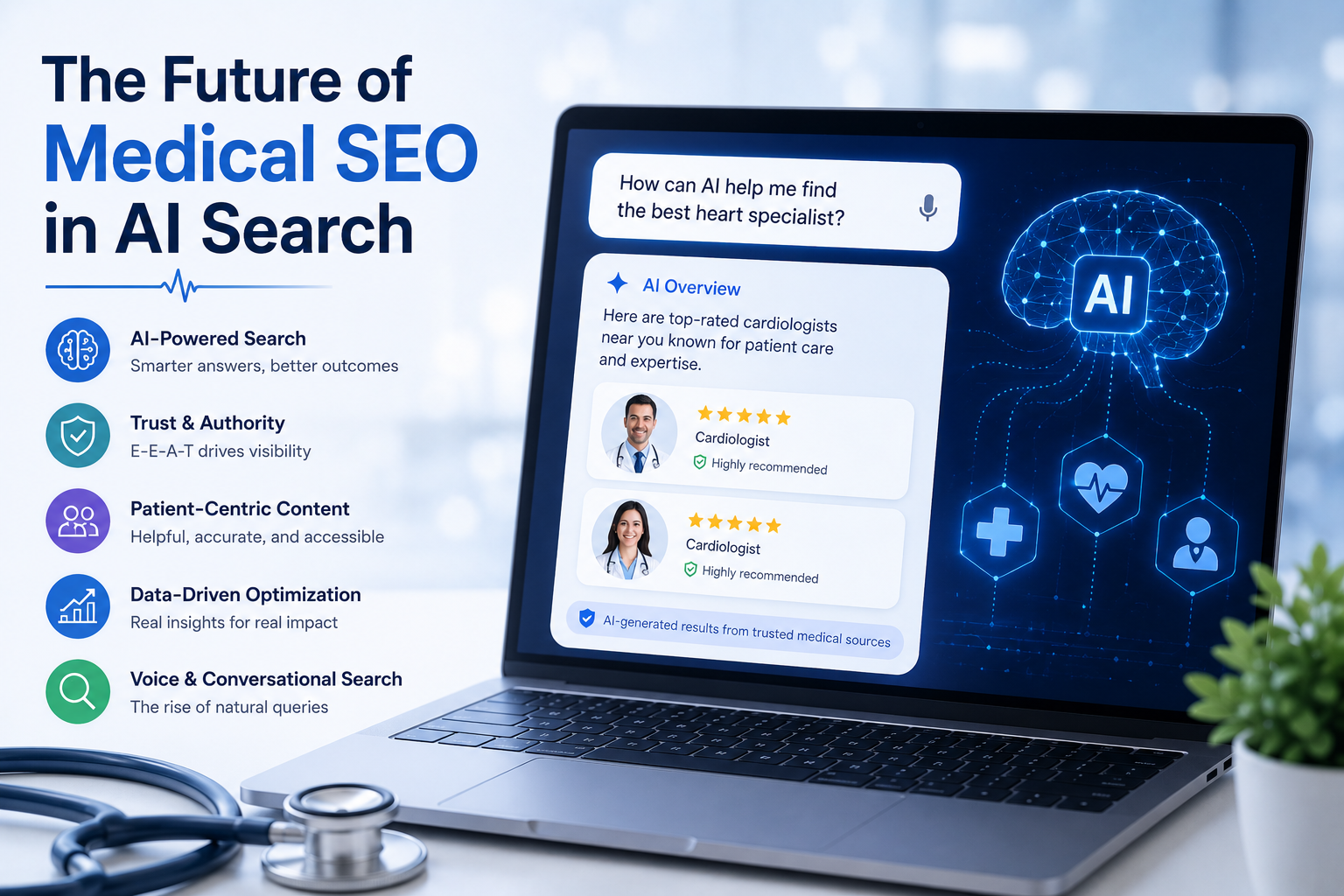
The healthcare industry is experiencing one of the most significant shifts in digital marketing history. Artificial intelligence is rapidly changing how people search for information, including how patients find doctors, research symptoms, compare healthcare providers, and make medical decisions.
For years, traditional search engine optimization focused on keywords, backlinks, and ranking positions. While these factors still matter, AI-powered search is introducing a new era where search engines can understand context, intent, relationships between entities, and user behavior more effectively than ever before.
As Google, AI assistants, and conversational search technologies continue to evolve, healthcare providers must adapt their SEO strategies to remain visible. Medical websites that fail to embrace these changes risk losing valuable traffic, patient inquiries, and online authority.
The future of Medical SEO Services is no longer just about ranking on page one. It is about becoming the most trusted and authoritative source that AI-powered search engines choose to reference and recommend.
Traditional search engines relied heavily on matching keywords to web pages. Users entered short search phrases, and search engines returned a list of websites based on relevance and authority.
AI search works differently. Instead of simply displaying links, AI-powered systems generate direct answers by analyzing multiple sources and understanding user intent.
For example, a patient searching “What causes chronic migraines?” may receive an AI-generated summary before viewing individual websites.
AI search engines evaluate:
They then combine information from authoritative sources to generate answers.
Healthcare content falls under Google’s YMYL (Your Money or Your Life) category.
Because medical information can affect health decisions, AI systems apply stricter standards when selecting content to display.
Healthcare websites must demonstrate expertise, accuracy, and trustworthiness to remain competitive.
Patients increasingly use natural language when searching online.
Examples include:
Healthcare websites must create content that answers these types of questions directly.
Voice assistants have changed search behavior significantly.
Patients now ask:
Optimizing for voice search is becoming an essential part of Medical SEO Services.
Patients often use AI tools to understand symptoms, treatment options, and healthcare providers before scheduling appointments.
This trend will continue to grow as AI search becomes more sophisticated.
Even in an AI-driven environment, local intent remains strong.
Patients frequently search for:
Local SEO will remain critical for healthcare providers.
AI-generated answers often provide immediate information within search results.
This may reduce clicks to websites for simple informational searches.
Search engines increasingly focus on delivering concise answers.
Healthcare websites should structure content clearly to increase the chances of being referenced.
Authority is becoming one of the most important ranking factors.
Search engines want confidence that medical information comes from credible sources.
Generic content is no longer enough.
Healthcare websites must create detailed, accurate, and patient-focused resources.
AI Overviews are AI-generated summaries displayed directly within search results.
These summaries answer questions without requiring users to visit multiple websites.
To improve visibility:
Common issues include:
Healthcare content should reflect real-world experience whenever possible.
Medical information should be created or reviewed by qualified professionals.
Authority is built through:
Trust signals include:
Because healthcare information affects people’s well-being, search engines evaluate medical content more rigorously than many other industries.
Entity SEO focuses on relationships between people, organizations, places, treatments, and medical conditions.
Search engines increasingly understand these relationships.
Healthcare websites should clearly connect:
Schema markup helps search engines understand healthcare content.
Important schema types include:
Strong entity signals help healthcare providers appear within Google’s Knowledge Graph and AI-generated responses.
Search engines now understand context and user intent.
Repeating keywords excessively provides little value.
Healthcare organizations should build content around specialties.
Example:
Cardiology Hub
Content hubs demonstrate expertise and strengthen topical authority.
Comprehensive coverage increases trust and visibility in AI search.
Answer common patient questions clearly.
Use:
Organize content using:
Connect related content to establish topic relevance.
Schema improves content understanding and visibility.
Voice searches are often longer and more conversational.
Focus on complete questions instead of short keywords.
Examples:
These searches often have high conversion potential.
Fast websites improve user experience and search performance.
Mobile optimization remains essential.
Search engines must access and understand content efficiently.
Schema markup helps AI systems interpret healthcare information accurately.
Positive user experiences support long-term SEO success.
Maintain complete and accurate profiles.
Patient reviews continue to influence visibility and trust.
Create location-specific content and service pages.
Build authority within your service areas.
AI-generated answers will become increasingly common.
Search results will become more tailored to individual users.
AI may anticipate healthcare needs before patients complete searches.
Trust and authority will become even more important ranking factors.
Search engines will continue improving their understanding of medical relationships and healthcare knowledge.
High-quality content remains the foundation of Medical SEO Services.
Demonstrate expertise across all content.
Provide useful, accessible information.
Healthcare information must remain current and accurate.
Healthcare SEO requires expertise in both search optimization and medical marketing.
✔ Create question-based content
✔ Optimize for AI Overviews
✔ Improve content structure
✔ Display credentials
✔ Add author information
✔ Build trust signals
✔ Improve page speed
✔ Ensure mobile usability
✔ Fix crawl errors
✔ Optimize Google Business Profile
✔ Build reviews
✔ Create location pages
✔ Build topic clusters
✔ Publish expert content
✔ Update outdated pages
✔ Medical Organization Schema
✔ Physician Schema
✔ FAQ Schema
✔ Online booking
✔ Strong calls-to-action
✔ Clear contact information
The future of Medical SEO is being shaped by artificial intelligence, conversational search, entity understanding, and increasing demands for expertise and trustworthiness. Healthcare organizations that continue relying on outdated SEO strategies may struggle to maintain visibility as AI-powered search evolves.
Success in the AI era requires more than keywords. Healthcare websites must demonstrate authority, answer patient questions comprehensively, optimize for AI-driven search experiences, and build trust through high-quality content.
Medical SEO Services are becoming increasingly important as healthcare providers navigate these changes. Organizations that invest in future-focused SEO strategies today will be better positioned to attract patients, build authority, and remain competitive tomorrow.
At The Medical SEO, we help healthcare organizations adapt to AI-powered search and develop sustainable SEO strategies designed for long-term growth and patient acquisition.
AI search uses artificial intelligence to generate answers and understand user intent beyond traditional keyword matching.
They provide direct answers in search results and increase the importance of authoritative content.
No. SEO remains essential, but strategies must evolve to align with AI-powered search.
Entity SEO focuses on relationships between healthcare providers, treatments, conditions, and organizations.
It helps search engines evaluate the credibility and trustworthiness of healthcare content.
By creating authoritative content, demonstrating expertise, using structured data, and building topical authority.
Schema helps search engines understand content and entities more accurately.
Yes. Local searches remain critical for patient acquisition.
Focus on expertise, content quality, authority building, and patient-focused information.
AI Overviews, entity SEO, topical authority, voice search, and trust-based ranking signals.